Growing Acceptance and Concerns: Cannabis Usage Trends in the US

Growing Acceptance and Concerns: Cannabis Usage Trends in the US
In a recent survey, half of Americans indicated that they have experimented with marijuana, sparking concerns about the implications of the rapid legalization of cannabis across the country. The findings highlight a potential increase in usage, particularly among young adults.

Conducted by the polling firm Gallup, the survey revealed that 50 percent of respondents reported recreational marijuana use, representing a two-percentage-point rise from a similar survey conducted at the beginning of 2022. Additionally, the proportion of regular users has climbed to 17%, more than doubling the figures recorded in 2013.

Gallup noted, “As marijuana has become more available to Americans and legal in an increasing number of states, their reports of use and experimentation have increased too. Now, half of the country has tried it, while the other half say they never have.”
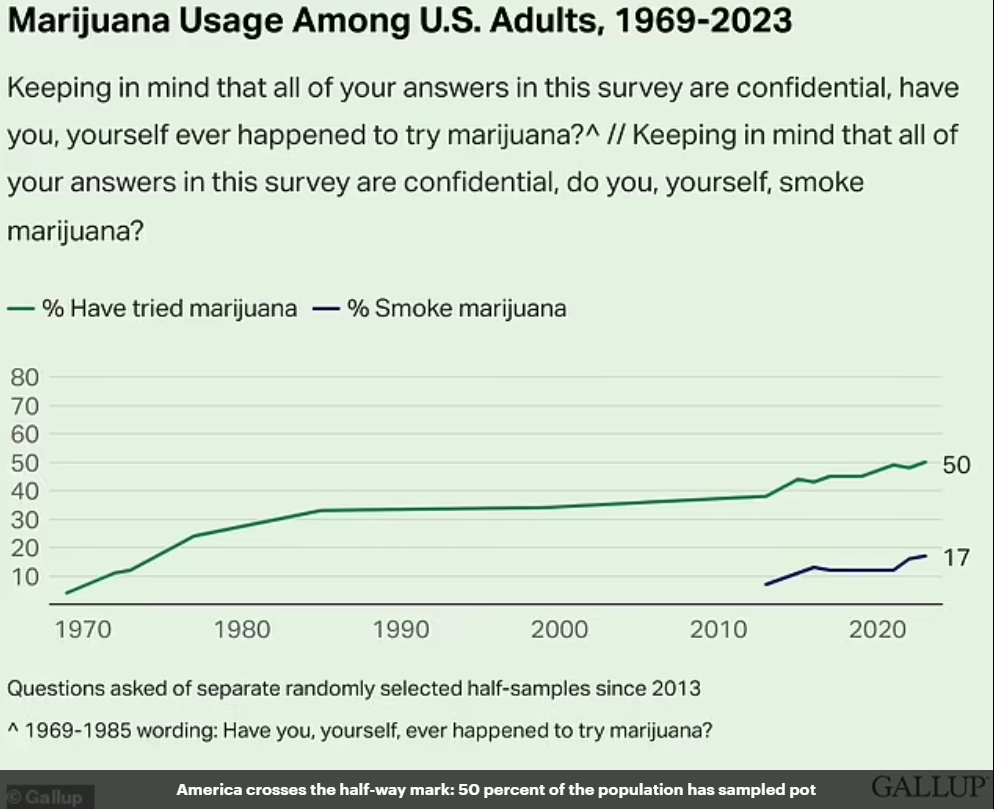
The survey’s results underscore concerns that the expansion of cannabis legalization across 23 states and Washington DC might be contributing to heightened consumption, especially among adolescents and young adults who are particularly vulnerable to its potential negative impacts. Proponents of marijuana emphasize its health and social benefits, while critics caution that widespread usage could lead to elevated rates of mental health issues, substance abuse, and impaired driving accidents.

Child and adolescent psychiatrist Bobby Smyth voiced his apprehensions on social media, highlighting that the rise in drug dependence and emergency room visits among both young and older individuals might be linked to legalization. Smyth also pointed out that prominent medical bodies like the American Medical Association oppose cannabis legalization.

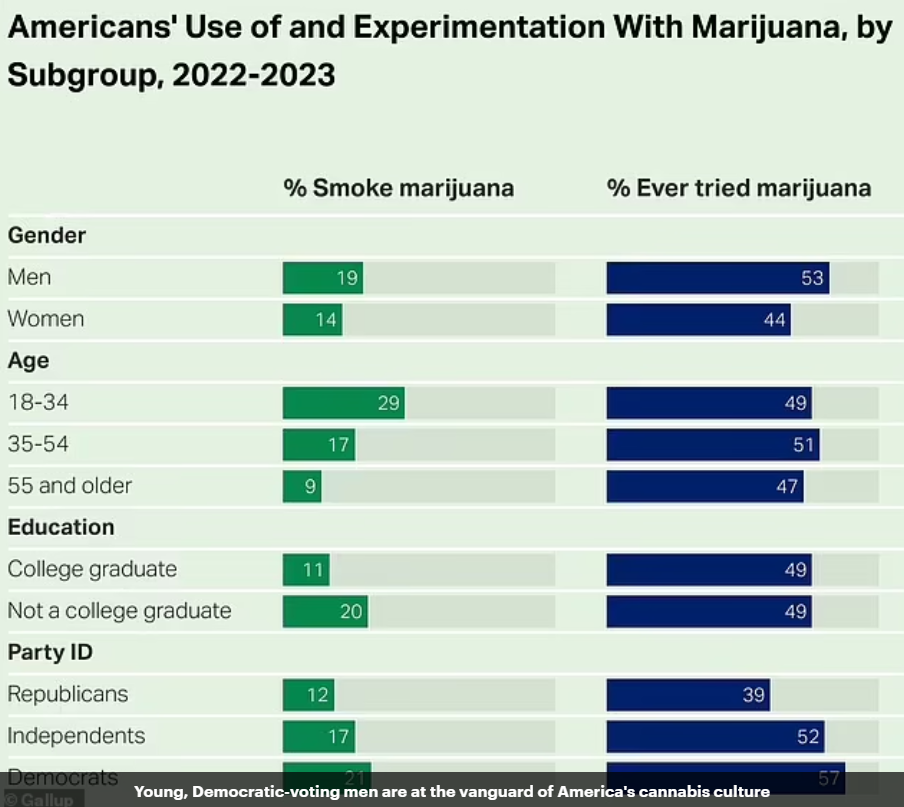
The US Centers for Disease Control and Prevention (CDC) have stated that marijuana use can disproportionately affect young people, contributing to adverse effects on brain development and mental health. According to Gallup researchers, cannabis consumption is most prevalent among adults aged 18 to 34, with nearly one-third of this demographic using it regularly, in contrast to just 9 percent of those aged 55 and older.

The survey also revealed a political disparity, with 57 percent of Democrats, 52 percent of independents, and 39 percent of Republicans reporting having tried marijuana.

Notably, the legalization trend continues to expand, with Minnesota becoming the 23rd state to legalize recreational marijuana earlier this year. However, as legalization gains traction, scientists are increasingly sounding alarms about the potential risks associated with cannabis use.

In February, experts from Stanford University unveiled research suggesting that cannabis users face up to a third higher risk of experiencing heart attacks compared to non-users. Additionally, researchers backed by the National Institute on Drug Abuse cautioned in May that marijuana might be contributing to a 30 percent surge in schizophrenia cases among young men.
In the same month, DailyMail.com featured accounts from relatives of individuals who suffered adverse effects from cannabis abuse. One such account was that of Sonia Jimenez, whose son, Josh, passed away in December 2021 due to what she believes was chronic cannabis use-induced suicide.

Josh’s sister, Alex, shared details of his deteriorating condition following his initiation of cannabis consumption in 9th grade. His academic performance declined, and he exhibited symptoms of paranoia, including vivid hallucinations. He also survived a severe car crash caused by cannabis-induced impairment and was involved in a fire incident due to his altered state.

Tragically, Josh eventually succumbed to his struggles, highlighting concerns about the potency of the strains he consumed. Research indicates that high doses of THC, the psychoactive component of cannabis, could contribute to various psychiatric disorders, including depression, schizophrenia, and psychosis.

The survey results and subsequent discussions emphasize the growing complexities surrounding marijuana usage, including both the acceptance and concerns associated with its increasing prevalence. As legalization progresses, striking a balance between individual freedoms and safeguarding public health remains a significant challenge for policymakers, medical professionals, and society as a whole.

Source: Dailymail.co.uk

EXPLORE MORE NEWS
Major Corporations Investing in Cannabis

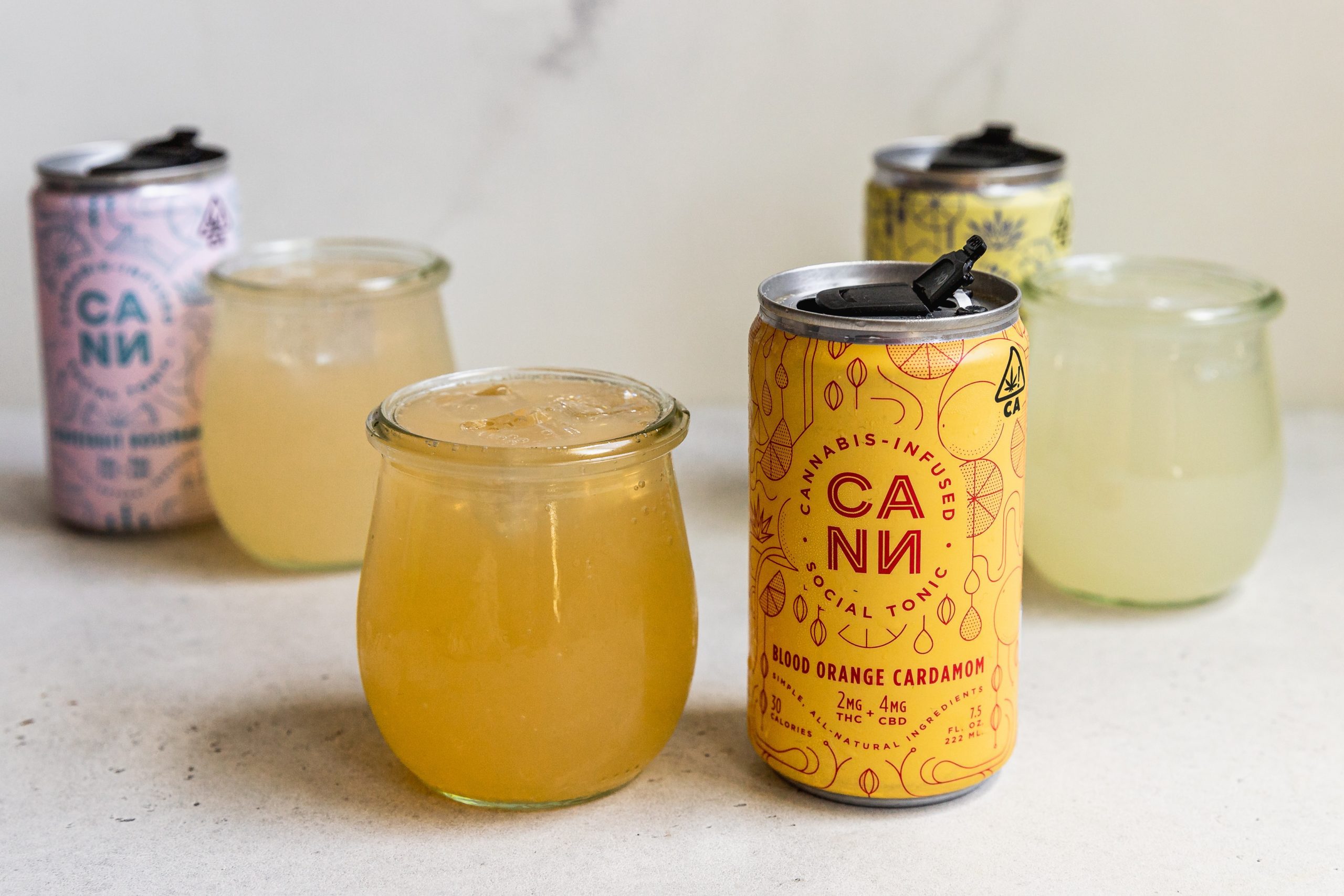
As cannabis legalization continues to spread across the country, major corporations are increasingly taking notice and investing in the industry. In April of 2023, a major beverage company announced a $100 million investment in a cannabis-infused drink startup, signaling the growing trend of large corporations entering the cannabis space.

State-Level Tax Relief Provides Welcome Respite for U.S. Cannabis Industry

The U.S. cannabis industry is finally experiencing some much-needed tax relief as an increasing number of states pass laws to exempt businesses from Section 280E of the federal tax code. With 20 states having implemented these exemptions, cannabis operators are beginning to see a glimmer of hope amidst the burdensome tax landscape.

Unlocking Entrepreneurial Success in the Booming Cannabis Industry

In recent years, the cannabis industry has undergone a remarkable transformation, transitioning from an underground market to a legitimate and rapidly expanding sector. With the legalization and decriminalization of cannabis in various regions, entrepreneurial opportunities within the cannabis space have flourished. This comprehensive article explores the vast potential for entrepreneurship in the cannabis industry, covering crucial aspects such as starting a cannabis-related business, navigating complex regulations, crafting effective marketing strategies, exploring investment prospects, and drawing inspiration from successful stories.

South Dakota’s Medical Cannabis Program Surpasses Expectations, Raises Concerns

South Dakota’s foray into medical cannabis has far exceeded its initial projections, with the issuance of medical cannabis cards doubling the expected numbers. Since the program’s launch in 2021, the South Dakota Department of Health has issued approximately 11,500 medical cannabis cards, significantly surpassing the original projection of 6,000 cards to be issued by 2024.

Newsletter

Arkansas Medical Cannabis Sales Poised for Record Year with $23.2 Million in July

Arkansas Medical Cannabis Sales Poised for Record Year with $23.2 Million in July

The trajectory of medical cannabis sales in Arkansas continues to set new records, with transactions in the state soaring to $23.2 million in July. This robust performance propels the total sales of medical marijuana in Arkansas for the initial seven months of 2023 to an impressive $164.6 million. Remarkably, this figure surpasses the corresponding period’s sales from the previous year by a substantial margin of $7.3 million, as reported by Fayetteville TV station KNWA.

One notable factor contributing to this surge in sales is the marked increase in the number of medical marijuana cardholders within the state. Since the advent of August 2022, the count of patients has surged from 88,893 to 94,059, in accordance with data provided by the Arkansas health department. This expanding patient base is undoubtedly bolstering the state’s medical cannabis market.

Scott Hardin, the official spokesperson for Arkansas’ Department of Finance and Administration, has expressed optimism regarding the foreseeable sales trajectory. He stated that if the current sales patterns persist over the coming months, the total sales for the entirety of 2023 could potentially exceed an impressive $280 million.

In the realm of specific sales figures, medical marijuana dispensaries in Arkansas have effectively marketed and distributed 29,057 pounds of medical cannabis during the initial six months of 2023. This noteworthy achievement reflects a remarkable 23% increase when juxtaposed with the analogous period in the previous year.

The state’s proactive approach to medical cannabis regulation and the growing acceptance of its therapeutic benefits are likely contributors to the surging sales figures. With an expanding patient base and a positive trajectory in sales, Arkansas is solidifying its position as a significant player in the medical cannabis industry.

Arkansas’ medical cannabis market continues to make substantial strides, as evidenced by the record-breaking sales figures in July and the overall upward trend in transactions throughout 2023. The expanding number of medical marijuana cardholders and the persistent efforts of dispensaries are collectively driving this exceptional performance. The state’s potential to achieve sales exceeding $280 million for the year underscores the robust growth of the medical cannabis sector in Arkansas.


Source: Mjbizdaily

EXPLORE MORE NEWS

Major Corporations Investing in Cannabis

As cannabis legalization continues to spread across the country, major corporations are increasingly taking notice and investing in the industry. In April of 2023, a major beverage company announced a $100 million investment in a cannabis-infused drink startup, signaling the growing trend of large corporations entering the cannabis space.

Ohio Joins Ranks of Legal Cannabis States as Issue 2 Passes with 57% Voter Approval

In a groundbreaking decision, Ohio has officially become the 24th state to legalize adult-use cannabis. With a resounding 57% of voters supporting the ballot proposal known as Issue 2, this victory marks a significant shift in the landscape of U.S. states where recreational marijuana is legal. This landmark decision paves the way for individuals aged 21 and older to purchase and possess up to 2.5 ounces of cannabis while also permitting home cultivation of up to six plants per person and 12 plants per residence if at least two adults reside there. Furthermore, a 10% tax will be levied on cannabis purchases, with the revenue allocated to cover administrative costs, addiction treatment programs, municipalities with dispensaries, and social equity initiatives and job programs.

Here is a map of all the cannabis stores in Arizona 2023

In November 2020, Arizona voters made a historic decision by legalizing recreational cannabis in the state. Since then, the cannabis industry has been on a steady rise, transforming the state’s economic and social landscape. If you’re looking to explore the Green Desert and understand the ins and outs of cannabis shops in Arizona in 2023, you’ve come to the right place. In this comprehensive guide, we’ll take you on a journey through the legal framework, the types of cannabis shops you can find, their geographic distribution, notable brands and products, the customer experience, pricing and taxes, health and safety considerations, and even a glimpse into the future of the industry.

NCAA Medical Committee Calls for End to Cannabis Penalties for College Athletes

In a significant and up-to-date policy shift, the NCAA (National Collegiate Athletic Association) medical committee has recommended that college athletes should no longer face penalties for using cannabis. This progressive stance reflects the evolving landscape of cannabis regulations across the United States. The committee has firmly asserted that drug testing efforts should be redirected towards detecting performance-enhancing substances, leaving cannabis use without punitive measures. This recommendation comes after the committee conducted a thorough review of existing policies and solicited input from member organizations. It anticipates that the final decision on this matter will be made in the fall, following consultations and legislative processes within each of the NCAA’s governing bodies.

Newsletter

Alabama Medical Cannabis Commission Makes Second Attempt to Grant Business Licenses

Alabama Medical Cannabis Commission Makes Second Attempt to Grant Business Licenses

The Alabama Medical Cannabis Commission convened on Thursday for a renewed effort to allocate licenses to companies vying for participation in the state’s burgeoning medical cannabis industry.

The proceedings commenced at 10 a.m. in a fully occupied room. Approximately 20 minutes later, the commission opted to enter an executive session – a closed-door gathering. The open meeting is scheduled to recommence around 1:30 p.m.

Legal counsel for the AMCC, William Webster, clarified that the closed session would involve commissioners receiving details about the license applicants. Subsequently, individual lists of nominees for each license category would be compiled.

Webster emphasized that nominees’ lists would remain undisclosed during the closed session. Deliberations and voting on nominees are slated to take place once the meeting reopens to the public at 1:30 p.m.

Webster outlined the process, stating, “Deliberations will not occur during the executive session. The focus will be on sharing information related to the applicants. Each commissioner will confidentially generate a list of nominations for each category. These nominations will not be revealed during the closed session, and there will be no voting during that time.”

One criticism stemming from the initial round of license awards was the lack of public deliberation; decisions were unveiled following the executive session, which led to concerns about transparency.

Webster indicated that the forthcoming open meeting would solely address applicants who had received nominations.

The executive session was also designated to address three other topics permitted under Alabama’s open meetings law. These topics encompass discussions related to individuals’ general reputation, character, professional competence, and ongoing or potential lawsuits involving the commission.

On June 12, the AMCC awarded licenses to 21 companies from a pool of 90 applicants.

However, only four days later, the AMCC suspended these awards, citing potential inconsistencies in the tabulation of scores that aided in ranking the applicants. Consequently, the licenses were not granted.

In response, seven companies that had been unsuccessful in securing licenses on June 12 filed a lawsuit challenging the commission’s procedures. One licensed company also became a defendant in the case.

The licenses cover a spectrum of roles, including cultivation, processing, transportation, testing, and operating dispensaries. Integrated companies that combine several of these functions are also included.

Prior to the executive session on Thursday morning, Rex Vaughn, a Huntsville farmer, was elected as the chairman, succeeding Dr. Steven Stokes. Vaughn, previously the vice chairman, is affiliated with the Alabama Farmers Federation. Stokes, a radiation oncologist from Dothan, resigned from the chairmanship, as he is a trustee at the University of South Alabama, which contravened the commission’s operating rules.

Vaughn commended Stokes’ contributions and leadership, acknowledging their lasting impact. The AMCC also appointed Sam Blakemore, a pharmacist, as the new vice chair. Blakemore praised Stokes’ character and dignified leadership.

Before the licensing suspension, the AMCC anticipated product availability by late this year or early next year. The range of products encompasses gummies, tablets, capsules, tinctures, patches, oils, and other forms allowed by the legislation.

Qualifying patients with medical cannabis cards will be permitted to purchase these products from authorized dispensaries. The medical applications of these products extend to various conditions, including chronic pain, cancer-induced weight loss and nausea, depression, panic disorder, epilepsy, muscle spasms caused by diseases or spinal cord injuries, and PTSD, among others.

Alabama joins 37 other states that have sanctioned medical marijuana, as indicated by the National Conference of State Legislatures.


Source: AL.com

EXPLORE MORE NEWS

Major Corporations Investing in Cannabis

As cannabis legalization continues to spread across the country, major corporations are increasingly taking notice and investing in the industry. In April of 2023, a major beverage company announced a $100 million investment in a cannabis-infused drink startup, signaling the growing trend of large corporations entering the cannabis space.

Blue Dream’s Two Decades of Influence: Unraveling the Origins and Impact

From Haze to Skunk, OG to Cookies, the cannabis market has been shaped by remarkable strains that encapsulate their respective eras. Among them, Blue Dream emerged as a defining cultivar around 2003, reigning until approximately 2011 when shifting market preferences opened the door for a new strain to take the spotlight. As we commemorate two decades of Blue Dream’s legacy, it’s intriguing to note that despite its celebrated status as the “most popular strain on the planet” at one point, there remains a surprising shroud of uncertainty surrounding its true origins and characteristics.

How to search for a Cannabis License in New Jersey 2023

The cannabis industry in New Jersey has been experiencing significant growth, and obtaining a cannabis license is a crucial step for individuals and businesses looking to participate in this burgeoning market. With the recent legalization of adult-use cannabis in the state, the demand for licenses has never been higher. This guide aims to provide a comprehensive overview of how to search for a cannabis license in New Jersey in 2023.

State-Level Tax Relief Provides Welcome Respite for U.S. Cannabis Industry

The U.S. cannabis industry is finally experiencing some much-needed tax relief as an increasing number of states pass laws to exempt businesses from Section 280E of the federal tax code. With 20 states having implemented these exemptions, cannabis operators are beginning to see a glimmer of hope amidst the burdensome tax landscape.

Newsletter

New Jersey’s Cannabis Tax Revenue Alleviates Violence with $5 Million for Prevention Efforts

New Jersey’s Cannabis Tax Revenue Alleviates Violence with $5 Million for Prevention Efforts

In a remarkable step towards promoting community safety and well-being, New Jersey’s state program, initiated in 2021, continues to make strides by allocating $15 million to bolster Community-Based Violence Intervention (CBVI) programs. Governor Phil Murphy and Attorney General Matthew J. Platkin unveiled this groundbreaking initiative, which earmarks a portion of its funding from the cannabis tax revenue, aimed at supporting community-led organizations committed to violence prevention.

Since its inception, the Murphy administration has channeled over $40 million into CBVI programs, exemplifying a strong commitment to reducing violence across the state. This year, a significant portion of $5 million has been allocated to the initiative from the Cannabis Regulatory, Enforcement Assistance, and Marketplace Modernization Fund.

In a statement, Governor Murphy highlighted the program’s dedication to eradicating violence-ridden pockets within the state. He expressed gratitude for the unwavering commitment of Attorney General Platkin and his team in creating safer communities through initiatives like CBVI programs.

The CBVI programs concentrate on implementing “interventions and protective activities” in regions where violence is most rampant. Utilizing a public health approach to disrupt cycles of violence, particularly gun violence, these initiatives encompass diverse strategies such as mentoring programs, street outreach, trauma support services, de-escalation training for high-risk individuals, targeted afterschool activities, and vocational training.

Emphasizing the paramount importance of public safety, Attorney General Platkin underscored the administration’s holistic approach, directing support towards community-led violence intervention efforts that operate at the grassroots level. He credited Governor Murphy’s leadership for perpetuating the state’s historic investment in this critical endeavor, ensuring that resources flow to grassroots organizations in alignment with the state’s public safety mission.

Eligible applicants seeking a share of the available funds (up to $750,000) must demonstrate a track record of success in violence intervention work. Applications can be submitted to the Department of Law and Public Safety until September 26, falling within two categories: “Tertiary Prevention” encompasses services like de-escalation, mediation, mentorship, and street outreach teams, while “Primary or Secondary Prevention” targets violence-prone areas with a history of high violence rates.

This marks the third consecutive year of the CBVI funds’ allocation, with the program’s scope expanding to include 31 community organizations statewide. In 2022, the program allocated a portion of $20 million to bolster violence intervention efforts, following the initial offering of $10 million in 2021.

The trend of states utilizing cannabis tax funds for community benefits is not unique to New Jersey. California, for instance, has allocated a portion of its $48 million cannabis tax revenue to support local organizations. This funding aids a range of initiatives such as equity-focused organizations, public health agencies, and youth support programs, reflecting a growing trend in utilizing cannabis revenue for societal betterment.

Furthermore, California’s cannabis tax revenue has fueled various grant programs aimed at community development. Initiatives, such as the Local Jurisdiction Retail Access Grant, have distributed millions to local governments, facilitating the creation of cannabis licensing programs in regions that permit cannabis businesses.

Governor Murphy’s commitment to enhancing public safety was evident in February 2021 when he signed the New Jersey Cannabis Regulatory, Enforcement Assistance, and Marketplace Modernization Act into law, officially legalizing adult-use cannabis. The implementation of adult-use cannabis sales in April 2022 marked a significant milestone, resulting in a surge of licensed cannabis businesses from the initial 13 to 24 within a year.

Sales data from Q3 2022 reported an impressive figure of over $100 million in adult-use cannabis sales. Jeff Brown, Executive Director of the New Jersey Cannabis Regulatory Commission, noted that this is merely the beginning of the state’s cannabis potential. With 36 annual licenses awarded, including 15 for dispensaries, Brown anticipates market growth through increased competition and expanded locations, leading to a broader customer base and potentially more accessible prices.

Recent data from the New Jersey Cannabis Regulatory Commission highlights the sector’s robust performance, with Q1 2023 recording significant figures of $474,407,516 in recreational cannabis gross receipts and $204,731,182 in medical cannabis gross receipts.

New Jersey’s groundbreaking approach to violence prevention through CBVI programs, fueled by cannabis tax revenue, stands as a testament to the state’s commitment to community safety. By investing in grassroots organizations and innovative strategies, the state continues to pave the way for societal betterment, illustrating the potential for positive change that can arise from effectively utilizing cannabis tax funds.

Source: HighTimes

EXPLORE MORE NEWS

Major Corporations Investing in Cannabis

As cannabis legalization continues to spread across the country, major corporations are increasingly taking notice and investing in the industry. In April of 2023, a major beverage company announced a $100 million investment in a cannabis-infused drink startup, signaling the growing trend of large corporations entering the cannabis space.

Cannabis Unveiled: Exploring the Wellness Benefits of a Green Revolution

Cannabis once shrouded in controversy and stigma, is experiencing a remarkable transformation in public perception and legal status. Beyond its recreational use, cannabis is increasingly being recognized for its potential health and wellness benefits. This article delves into the world of cannabis and explores the various ways it can contribute to our well-being, including pain management, stress relief, and sleep aid. We’ll also discuss the growing presence of cannabis in alternative medicine and the emerging trends within the wellness industry.

Cannabis and Mental Health: Unraveling the Complex Connection

The relationship between cannabis use and mental health is a subject of significant interest and debate. It is crucial for individuals to have access to diverse perspectives and make informed choices when it comes to enjoying cannabis. Understanding the complex connection between cannabis and mental health is essential for responsible decision-making and the development of effective and safe enjoyment of cannabis products.

Revolutionary Shift: US Health Department Proposes Reclassifying Marijuana from Schedule I to Schedule III

In a groundbreaking move that has the potential to reshape the landscape of cannabis regulations, the U.S. Department of Health and Human Services (HHS) has taken a bold step by formally recommending the reclassification of marijuana from Schedule I to Schedule III under federal law. This historic decision signifies a seismic shift in perspective, indicating that the nation’s premier health agency no longer views cannabis as a substance with high abuse potential and zero medical value.

Newsletter

Cannabis Industry Insights: Navigating Legalization, Market Growth, and Emerging Trends

Cannabis Industry Insights: Navigating Legalization, Market Growth, and Emerging Trends

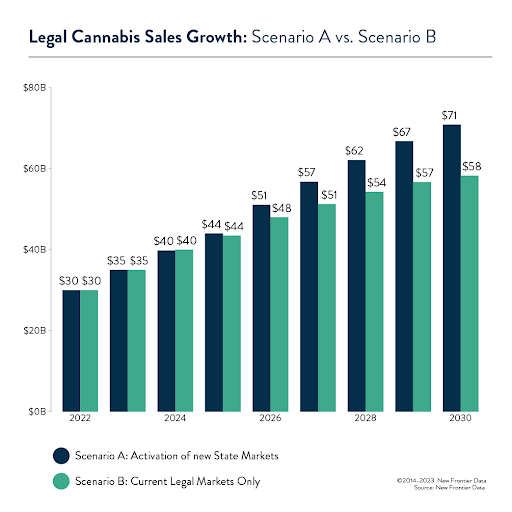
Setting the stage, it’s important to note that 24 U.S. states have legalized both Adult-Use and Medical-Use cannabis, 16 states have sanctioned Medical-Use exclusively, and 11 states maintain no legal cannabis market whatsoever. This translates to nearly 75% of Americans, roughly 250 million individuals, residing in states with varying degrees of access to high-THC legal cannabis. According to New Frontier Data’s analysis, the U.S. cannabis market’s legal sales were estimated at approximately $30 billion in 2022, and projections indicate they are poised to surpass $35 billion in 2023.

Despite the industry’s ongoing journey toward mainstream acceptance, it grapples with multifaceted challenges including federal policy inaction, downward price pressures, and limited access to capital. However, a particularly significant thorn in the industry’s side is the persistent dominance of the illicit market.

Illicit cannabis sales skyrocketed to $77 billion in 2022, more than double the total legal sales during the same period. Even within existing legal markets, New Frontier Data’s forecasts indicate that the illicit market will maintain its stronghold over legal sales until 2030.

Notably, an increasing number of consumers are opting to purchase their cannabis from brick-and-mortar dispensaries. A substantial 43% of current consumers revealed that their primary cannabis source is a physical dispensary—an impressive upswing from the previous year’s 34%. It’s evident that local market dynamics play a pivotal role in determining where consumers choose to procure their cannabis products.

Anticipating future developments, it’s anticipated that new markets will emerge in the coming years. To explore a comprehensive list of markets tracked by New Frontier Data and their anticipated timelines for legalization, one can refer to the 2023 U.S. Cannabis Report. The advent of these markets would likely propel annual legal market sales forward, potentially enabling legal sales to surpass illicit sales by 2028. By 2030, it’s projected that the legal market could account for 58% of all cannabis sales in the United States.

When comparing the current landscape of legal states to this potential model, a remarkable $13 billion (equivalent to a 22% growth) in annual sales could materialize by 2030. Furthermore, if these states proceed to expand legal access within the next few years, only three states would remain devoid of a legal cannabis market. This scenario would signify that an impressive 94% of Americans would reside in states where some form of high-THC legal cannabis is accessible.

For those seeking deeper insights into the cannabis industry’s most pressing challenges and promising opportunities, as well as an exploration of shifting consumer preferences since the previous year, a valuable resource is Equio—an essential reference point for staying informed.

Source: NewFrontierData

EXPLORE MORE NEWS

Major Corporations Investing in Cannabis

As cannabis legalization continues to spread across the country, major corporations are increasingly taking notice and investing in the industry. In April of 2023, a major beverage company announced a $100 million investment in a cannabis-infused drink startup, signaling the growing trend of large corporations entering the cannabis space.

A Look at How California Celebrates Legalization of Recreational Cannabis

California, the first state to legalize medical marijuana over two decades ago, has now taken a significant step forward by legalizing recreational marijuana for adults aged 21 and older. As the most populous state in the United States, this move marks a significant development in the nationwide trend toward marijuana legalization. However, the federal government still classifies marijuana as a controlled substance, highlighting the ongoing conflict between state and federal laws. This article explores the implications of this momentous decision and the challenges that lie ahead for California.

National CBD Day: Exploring the Evolution, Science, and Celebration of CBD

In the dynamic world of wellness and natural health, National CBD Day, observed annually on August 8th in the United States, has gained prominence as a day of reflection and appreciation for the journey and significance of cannabidiol (CBD). This compound, derived from the cannabis plant, has transcended its mysterious origins to become a symbol of holistic well-being and a catalyst for widespread conversations about alternative remedies. This comprehensive blog post delves deeper into the history, science, and multifaceted ways of celebrating National CBD Day.

Newsletter